
West Nile Virus
What is West Nile virus (WNV)?
West Nile virus (WNV) is a flavivirus belonging to the same family as the viruses that cause dengue, yellow fever, Zika and Japanese encephalitis. It is transmitted by mosquitoes and circulates mainly among wild birds, which act as the virus’s main hosts. As it can also infect humans and other mammals through the bites of infected mosquitoes, it is considered a zoonotic virus. Although most human infections are asymptomatic, a small proportion can lead to severe neurological disease.
Transmission
West Nile virus is usually transmitted through the bites of infected mosquitoes, particularly those belonging to the Culex genus. Mosquitoes acquire the virus when they feed on infected birds and can subsequently transmit it to other birds, which act as reservoirs and help sustain the transmission cycle.
WNV circulation depends not only on mosquito numbers but also on factors such as the abundance of infected mosquitoes, the extent of rice cultivation and the immunity acquired by bird and human populations.
Humans and horses can become accidentally infected with West Nile virus, but they are considered dead-end hosts, as the amount of virus in their blood is generally insufficient to infect new mosquitoes. They therefore do not contribute significantly to sustaining the transmission cycle.
The virus is not usually transmitted from person to person. Documented cases of such transmission are very rare and have been associated mainly with blood transfusions and organ transplants, as well as, exceptionally, transmission from mother to child during pregnancy, childbirth or breastfeeding.
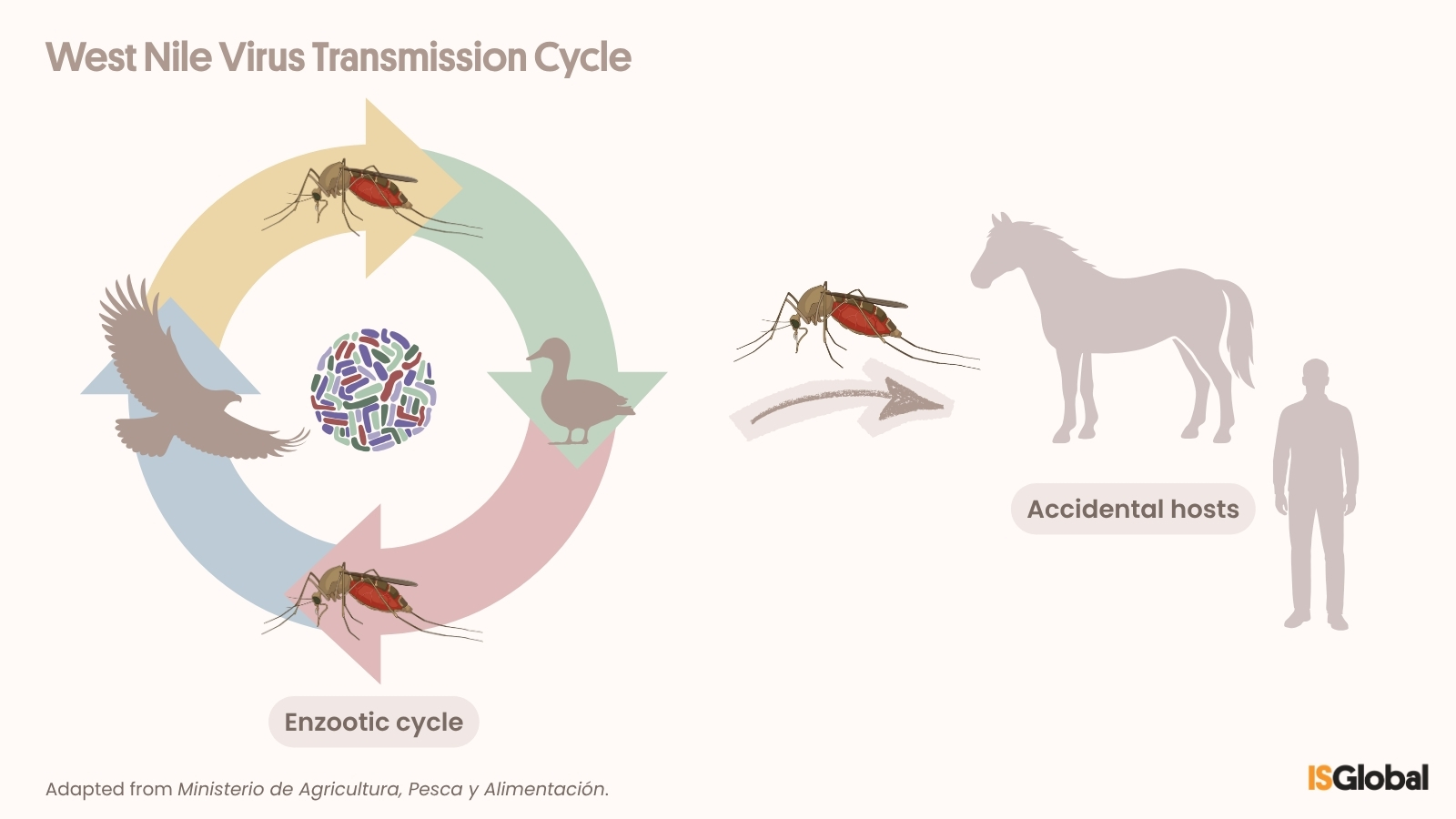
West Nile virus is maintained in a natural reservoir consisting of birds and mosquitoes. Occasionally, the bite of an infected mosquito disrupts the usual pattern of transmission and passes the infection to humans and horses, which are considered dead-end or secondary hosts.
Epidemiology and distribution of WNV
Over recent decades, West Nile virus has progressively expanded its geographical range. Although it was first identified in Uganda in 1937 and circulated mainly in Africa, the Middle East, western Asia and parts of Europe for much of the 20th century, its spread reached a new scale following its introduction to the United States in 1999. Within a few years, the virus had become established in North America, where it now circulates endemically among birds and mosquitoes.
Today, the virus is present in Africa, Europe, Asia, the Americas and Australia, and is considered one of the arboviruses with the widest global distribution. In temperate regions, transmission is seasonal and usually occurs between spring and autumn, coinciding with the period of greatest activity among mosquito vectors. Human infections are incidental and do not contribute to sustaining the transmission cycle.
In Europe, virus circulation has increased since the beginning of the 21st century. The 2018 outbreak, during which more than 2,100 human cases were reported in the European Union and neighbouring countries, highlighted the virus’s growing importance as a public health concern. Since then, the ECDC has documented new cases each year and the expansion of areas with local transmission, facilitated by the presence of migratory birds, mosquitoes and suitable environmental conditions.
The main vectors include mosquitoes of the Culex genus, particularly Culex pipiens and Culex perexiguus. These two species are widely distributed across the Mediterranean region and are particularly effective at transmitting the virus between birds and, occasionally, to humans.
Symptoms of West Nile virus
Approximately 80% of infected people do not develop any symptoms. When clinical symptoms occur, the most common presentation is West Nile fever, a generally mild illness that can cause fever, headache, severe fatigue, nausea or a skin rash.
Around 1 in 150 infected people develop neuroinvasive disease, an uncommon complication that can take the form of meningitis, encephalitis or acute flaccid paralysis. The risk is higher among older people and those with weakened immune systems. Although most infections are mild or asymptomatic, severe cases may require hospitalisation and can sometimes lead to neurological complications or death.
Diagnosis and treatment
Diagnosis is based on detecting antibodies against the virus or its genetic material in blood or cerebrospinal fluid, alongside a clinical and epidemiological assessment of the patient. In Andalusia, measures have been introduced in primary care to help identify cases, including testing patients with meningitis or encephalitis of unknown origin for possible West Nile virus infection.
There is currently no specific antiviral treatment and no vaccine authorised for human use. Medical care focuses on relieving symptoms and providing hospital-based supportive treatment in severe cases, particularly when the nervous system is affected. Effective vaccines are available to prevent the disease in horses and are used in veterinary medicine.
Prevention
As there is no vaccine authorised for human use, West Nile virus prevention relies on avoiding mosquito bites and implementing epidemiological and vector surveillance programmes. Using insect repellents and mosquito nets, wearing clothing that covers most of the body, and removing standing water where mosquitoes can breed are the most effective measures for reducing the risk of infection.
READ MORE
COLLAPSE
- ISGlobal’s 12th PhD Symposium Addresses The Challenges of Climate Change and Emerging Diseases(ISGlobal, 2026)
- Science, Cooperation and Impact in Uncertain Times(ISGlobal, 2026)
- West Nile Fever(Ministerio de Agricultura, Pesca y Alimentación, 2026)
- Symptoms of West Nile(CDC, 2026)
- Rather than Waiting for New Viruses to Emerge, We Should Be Looking for Them(ISGlobal, 2021)
MULTIMEDIA MATERIAL