
Hantavirus
What is hantavirus?
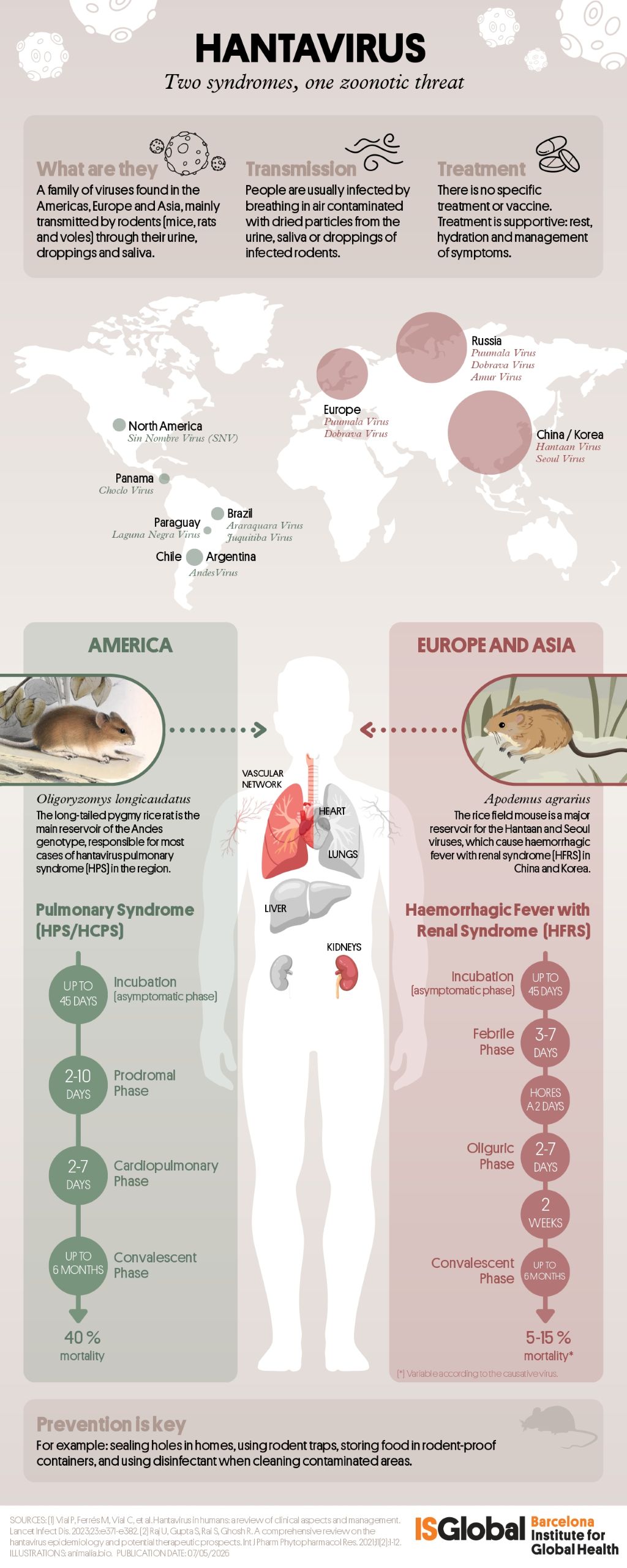
Hantaviruses are a group of RNA viruses belonging to the Hantaviridae family. Hantavirus infection is a viral zoonotic disease transmitted mainly by infected rodents, particularly mice and rats. Zoonotic diseases are infectious diseases that can spread from animals to humans.
In rodents, hantaviruses usually cause an asymptomatic and persistent infection. In humans, these viruses can cause two main clinical syndromes: hantavirus pulmonary syndrome (HPS), more common in the Americas, and haemorrhagic fever with renal syndrome (HFRS), which is more prevalent in Europe and Asia. The severity of the disease varies depending on the type of virus and the geographical region.
Transmission of hantavirus
Transmission from infected rodents
The main route of transmission is the inhalation of viral particles found in the urine, faeces or saliva of infected rodents. This typically occurs when these materials dry out and contaminated particles become airborne (aerosolisation) during sweeping, cleaning or moving objects in poorly ventilated spaces, allowing them to be inhaled. Transmission can also occur through the bite of an infected rodent.
In addition, infection may occur through fomites, meaning objects or surfaces contaminated with rodent secretions (tools, clothing, food, furniture, etc.) that act as indirect carriers of the virus. A person may become infected after touching contaminated surfaces and then touching their nose, mouth or eyes.
Person-to-person transmission
To date, person-to-person transmission has only been documented for the Andes virus (ANDV), a type of hantavirus, in occasional outbreaks in Argentina and Chile. This type of transmission has been rare and has required very close contact or has occurred in a hospital setting.
Symptoms
The incubation period — from exposure to the virus to the onset of symptoms — varies depending on the type of hantavirus. In the case of Andes virus (ANDV), the incubation period can be quite long; it is usually between two and three weeks, but may extend to six weeks.
Initial symptoms are generally non-specific and flu-like, including fever, headache, muscle aches, general malaise and fatigue. Some patients may also experience abdominal pain, vomiting and gastrointestinal symptoms.
- In hantavirus pulmonary syndrome, the illness may progress to severe respiratory distress and cardiopulmonary failure, with an estimated mortality rate ranging from 11.7% to 44.5%.
- In haemorrhagic fever with renal syndrome, it may progress to kidney involvement, haemorrhage and circulatory complications, with mortality rates varying from 0.1% to 12% depending on the hantavirus involved.
Although these conditions were traditionally regarded as two separate syndromes, it is now recognised that they may overlap and involve both pulmonary and renal complications.
Diagnosis
Early diagnosis is difficult because the initial symptoms are non-specific and may be mistaken for other viral infections such as influenza. For this reason, in addition to symptoms, clinical suspicion is based on a history of rodent exposure or stays in endemic areas, together with specific laboratory tests to detect the hantavirus or the antibodies produced by the body in response to infection.
Treatment
Currently, there is no approved specific treatment for hantavirus infection. Management is mainly supportive and focused on relieving symptoms.
- Symptom control: treatment of fever, muscle pain, headache and general discomfort through medication and supportive care.
- Hydration: administration of fluids to maintain fluid balance and prevent dehydration or blood pressure abnormalities.
- Close monitoring: continuous observation of the patient, particularly respiratory, cardiac and renal function, to detect any deterioration quickly.
- Respiratory and haemodynamic support in severe cases: use of oxygen therapy, mechanical ventilation or medication to stabilise circulation and blood pressure in cases of respiratory failure or shock.
- Prevention of complications and organ dysfunction: intensive care measures aimed at preventing failure of the lungs, kidneys or heart.
The antiviral drug ribavirin has been studied, but its clinical effectiveness has not been clearly established.
Prevention
Prevention is the most important measure against hantavirus and is based primarily on reducing contact with infected rodents and their secretions. Recommended measures include protecting homes and storage areas by sealing holes and possible entry points for rodents, storing food in rodent-proof containers, and using traps or pest-control measures.
It is also important to take extra precautions when cleaning enclosed or poorly ventilated spaces such as basements, barns and sheds. These areas should be ventilated and disinfected beforehand, dry sweeping or vacuuming contaminated surfaces should be avoided, and appropriate protective equipment such as N95 masks should be used in higher-risk situations.
At present, vaccines have only been approved in China and South Korea for certain types of haemorrhagic fever with renal syndrome, although their effectiveness remains uncertain.
Current situation
In May 2026, the World Health Organisation (WHO) is monitoring an outbreak of hantavirus linked to the cruise ship MV Hondius, specifically caused by the Andes virus (ANDV). The leading theory regarding the origin of the outbreak suggests that the index case became infected through contact with rodents prior to boarding. Several cases and deaths have been confirmed among people travelling on the cruise ship, who may also have been infected by infected rodents or by living in close quarters in enclosed spaces with an infected person.
The WHO considers the risk to the general public to remain low and describes the event as “serious but contained”.
READ MORE
COLLAPSE
- From Curiosity to the Fight Against Deadly Viruses: My Journey with Ebola and Nipah(ISGlobal, 2026)
- The Most Feared Pathogens: 9 Diseases that Could Cause a Major Epidemic(ISGlobal, 2025)
- A New List of Priority Pathogens that Could Cause the Next Pandemic(ISGlobal, 2024)
- What Will the Next Disease X Be?(ISGlobal, 2024)
- Marburg Virus Disease: Are Vaccines and Treatments in the Horizon?(ISGlobal, 2024)
MULTIMEDIA MATERIAL