
Climate change
What is climate change and what causes it?
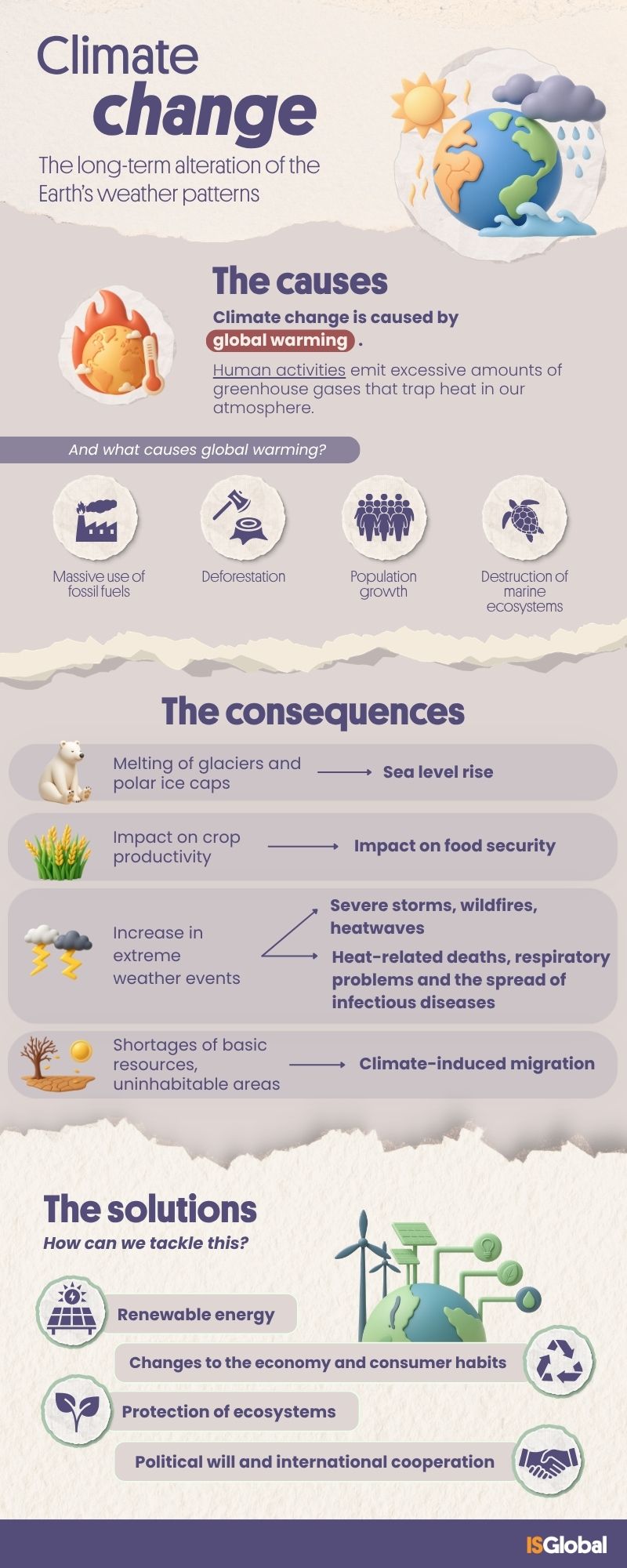
Climate change refers to the long-term alteration of the Earth’s climate patterns. These changes can unfold over decades, centuries or even thousands of years, until the climate system reaches a new state of balance.
Throughout Earth’s history, there have been natural climate shifts driven by factors such as variations in the planet’s orbit, changes in solar activity, major volcanic eruptions and meteorite impacts. One example is the last Ice Age, which ended around 11,000 years ago, when vast areas of the planet were covered in ice.
Today, however, the Earth is undergoing global warming at an unusually rapid pace as a result of human activity, particularly the release of greenhouse gases. Rising global temperatures are driving broader climate change, affecting rainfall patterns, increasing the frequency of extreme weather events and disrupting ecosystems. Because these changes are happening so quickly, many species struggle to adapt, increasing the risk of extinction and creating significant challenges for human societies.
Consequences of climate change
Global warming does not only raise air temperatures — it is also heating the oceans. One of the most serious consequences is sea level rise, caused mainly by the melting of glaciers and polar ice sheets. This poses a direct threat to coastal regions, where flooding, erosion and population displacement are becoming increasingly common. In addition, warmer oceans contribute to rising sea levels through thermal expansion, meaning water expands as it heats up.
Another major concern is food security. Climate change disrupts the conditions needed for agriculture by altering rainfall patterns and increasing the frequency of droughts, heatwaves and floods. These pressures reduce the productivity of staple crops such as wheat, maize and rice. The FAO warns that, with the global population expected to approach 10 billion in the coming decades, more food will need to be produced under increasingly difficult conditions, raising the risk of shortages and higher food prices.
Climate change is also intensifying extreme weather events. More powerful storms, more frequent wildfires and longer-lasting heatwaves are already well documented. These events affect not only ecosystems, but also human health, contributing to increased illness and mortality linked to extreme heat, respiratory problems and the spread of infectious diseases.
In many parts of the world, rising temperatures and prolonged droughts are reducing water availability and making farming more difficult, increasing competition for increasingly scarce resources. This can lead to large-scale population displacement, particularly in areas that may become partly uninhabitable because of extreme heat, desertification or rising sea levels. Climate migration, both within countries and across borders, presents major humanitarian, economic and political challenges.
How can climate change be tackled?
Addressing climate change requires a major transformation of the global energy system. This means replacing fossil fuels such as coal, oil and gas with renewable energy sources including solar, wind and hydropower. The aim is to reach net zero emissions by the middle of the century, drastically reducing the release of greenhouse gases.
However, the solution is not purely technological. It also requires deep changes in economic systems and consumer behaviour. Improving energy efficiency, expanding sustainable transport, promoting a circular economy and encouraging more responsible production and consumption models are all essential. Protecting ecosystems such as forests and oceans is equally important.
Finally, political commitment and international cooperation are crucial. Climate change is one of the greatest global challenges humanity has ever faced, demanding coordinated action between nations and a profound shift towards a more sustainable and environmentally responsible economic model.
READ MORE
COLLAPSE
- We Are Paying Twice for Climate Change: 4 Key Takeaways from the 2026 Lancet Countdown Report(ISGlobal, 2026)
- How Does Heat Affect the Health of Migrants Working in Agriculture in Southern Europe?(ISGlobal, 2025)
- A Study by the University of Murcia and ISGlobal Points to Human-Caused Climate Change as Responsible for the Increase in Fire Burned Area in California(ISGlobal, 2023)
- 4 Take-Home Messages on Climate Change(ISGlobal, 2022)
- “Our health-related behaviours can also help us to mitigate climate change and to adapt to it”(ISGlobal, 2021)
- Without Strong Mitigation Measures, Climate Change Will Increase Temperature-Attributable Mortality in Europe(ISGlobal, 2021)
MULTIMEDIA MATERIAL