

Plasmodium falciparum
What is Plasmodium falciparum?
Plasmodium falciparum (P. falciparum) is a parasitic protozoan responsible for the most severe form of malaria. It belongs to the genus Plasmodium, which includes five species capable of infecting humans: Plasmodium ovale, Plasmodium malariae, Plasmodium vivax, Plasmodium knowlesi and Plasmodium falciparum.
Of these, P. falciparum is the most lethal and the most prevalent in Africa, particularly in the sub-Saharan region, where the greatest global burden of the disease is concentrated.
Malaria transmission
Malaria caused by P. falciparum is mainly transmitted through the bite of female mosquitoes of the genus Anopheles, which act as vectors of the parasite.
Other, less common routes of transmission include congenital transmission (from mother to child during pregnancy or childbirth) and transmission through blood transfusions, organ transplants or the use of contaminated needles. However, the vast majority of cases are due to vector-borne transmission.
Life cycle of P. falciparum
The life cycle of P. falciparum is complex and requires two hosts: the Anopheles mosquito (definitive host) and the human (intermediate host).
- Infection in humans begins when an infected female mosquito bites a person to feed on blood. At that moment, it inoculates a form of the parasite called a sporozoite, which enters the bloodstream.
- Sporozoites rapidly travel to the liver, where they invade liver cells (hepatocytes). There, they multiply and transform into schizonts. When these rupture, they release thousands of merozoites that re-enter the bloodstream.
- Merozoites invade red blood cells (erythrocytes), where they initially develop into ring forms and later into trophozoites, continuing their asexual multiplication.
- During each cycle of multiplication, some parasites differentiate into gametocytes, which are the sexual forms. If another mosquito bites an infected person, it ingests these gametocytes along with the blood.
- Inside the mosquito, the gametocytes develop into male and female gametes, which fuse to form a zygote. This develops into an ookinete and then an oocyst, within which thousands of new sporozoites are produced.
Finally, the sporozoites migrate to the mosquito’s salivary glands, becoming ready to infect a new host when the insect bites again and the cycle restarts.
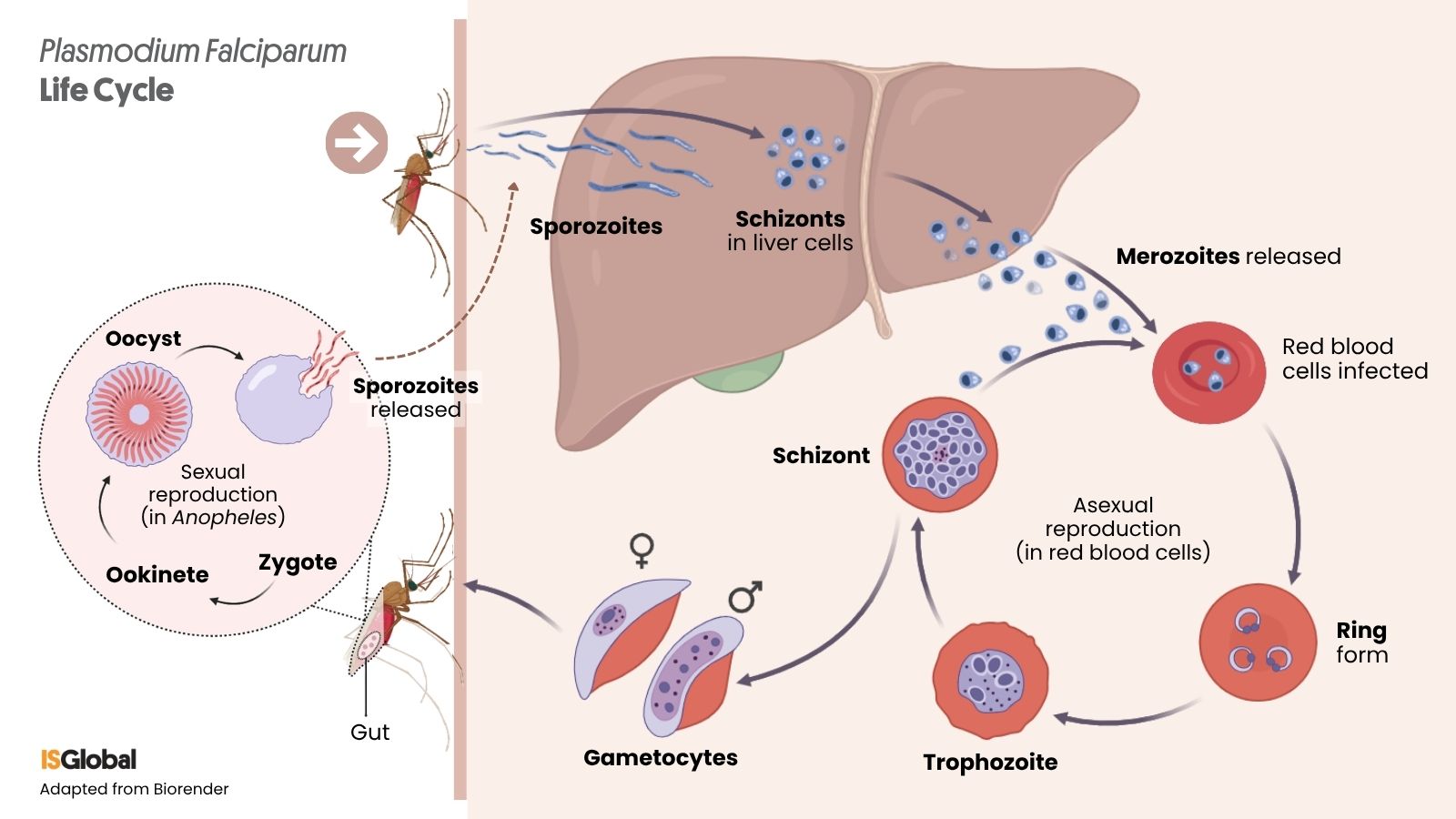
Life cycle of Plasmodium falciparum, alternating between the Anopheles mosquito and humans. Following a bite, sporozoites enter the bloodstream and migrate to the liver, where they form schizonts that release merozoites. These infect red blood cells and develop from ring forms into trophozoites and schizonts, multiplying asexually. When the schizonts rupture, they release new merozoites that reinfect additional red blood cells. Some differentiate into gametocytes, which, when ingested by another mosquito, transform into gametes, forming a zygote, then an ookinete and an oocyst, where new sporozoites are produced and migrate to the mosquito’s salivary glands, ready to infect a new host.
READ MORE
COLLAPSE
- New Study Sheds Light on How the Malaria Parasite Controls Its Genes(ISGlobal, 2025)
- A New Weak Spot Found in the Malaria Parasite(ISGlobal, 2025)
- New Study Describes the Genetic Diversity and Drug Resistance Markers of Malaria Parasites in Mozambique(ISGlobal, 2023)
- Assessing the Impact of Malaria Interventions Through Routine Sampling of Pregnant Women(ISGlobal, 2024)
- New Study Explores How the Malaria Parasite Responds to Artemisinin-Based Treatment in Infected Patients(ISGlobal, 2022)
- An ISGlobal Team Achieves Massive Sexual Conversion of the Malaria Parasite in a Dish(ISGlobal, 2020)