

Omics
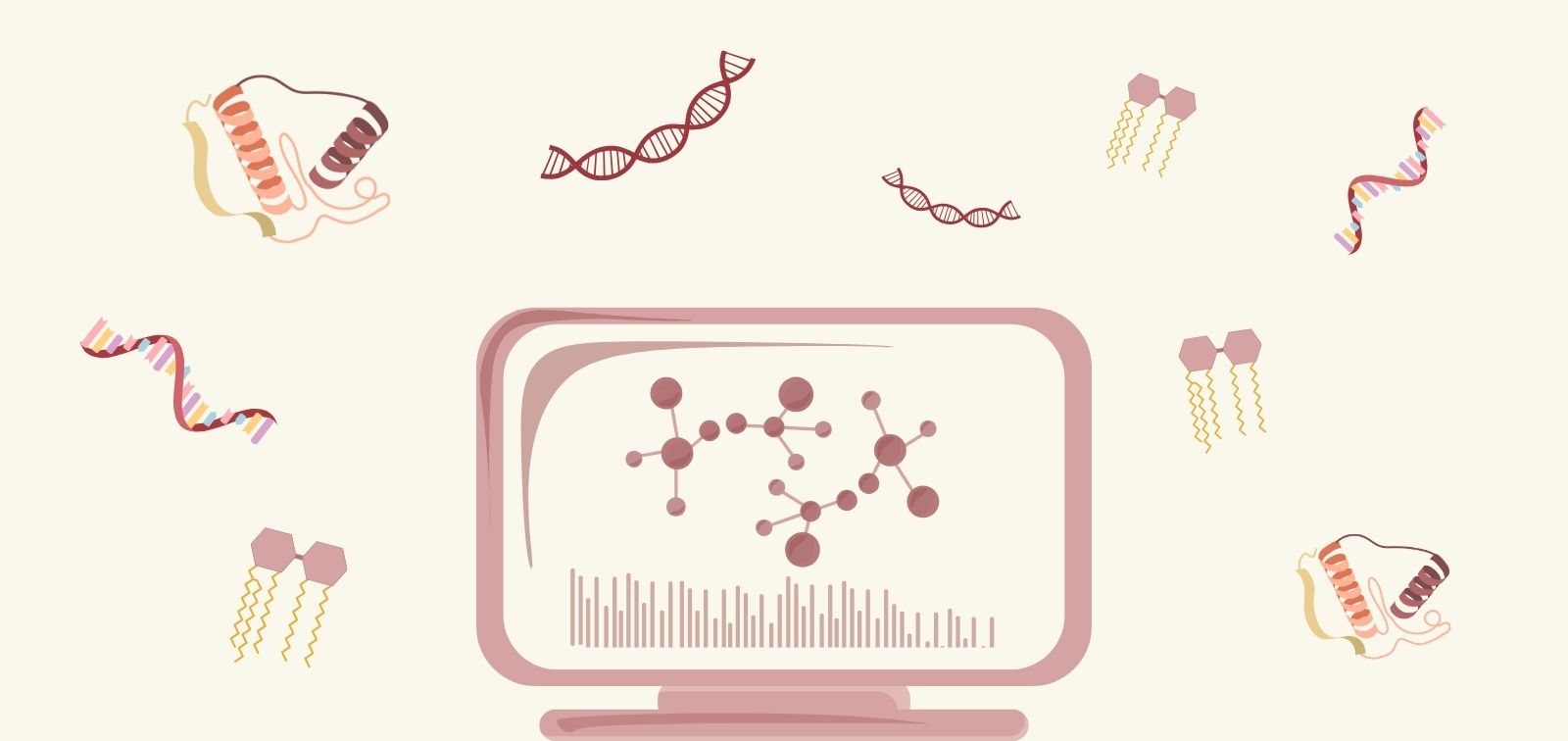
What are omics?
Omics are a group of disciplines and approaches that study, globally and on a large scale, large sets of components or characteristics of a biological system, such as a cell, tissue, organism or community of microorganisms. Unlike studies focused on one or a few specific elements, omics sciences make it possible to analyse a large number of biological characteristics simultaneously and study their relationships.
What do omics study?
The term «omics» encompasses different disciplines, usually named with the suffix -omics, which study different types of molecules and components of biological systems on a large scale. The main ones include:
- Genomics: studies the entire genetic material of an organism, that is, its genome, and analyses its DNA sequence (genes and other functional elements), as well as the variations it presents at population level and their relationship with biological functions.
- Transcriptomics: analyses the set of RNA molecules present in a cell, tissue or organism under given conditions. It makes it possible to determine which regions of the genome are being transcribed and in what quantities, thereby providing information about genome activity at a particular time and in a particular context. RNA can broadly be grouped into coding RNA, mainly messenger RNA (mRNA), which contains the information used to produce proteins, and non-coding RNA, which includes molecules with structural, catalytic or regulatory functions, such as ribosomal RNA (rRNA), transfer RNA (tRNA), microRNAs (miRNAs) and long non-coding RNAs (lncRNAs), among others. Some transcriptomic approaches focus mainly on messenger RNA, while others allow different classes of RNA to be studied, including non-coding RNAs.
- Proteomics: investigates the set of proteins present in a cell, tissue, biofluid or organism, as well as their quantities or modifications. As proteins perform numerous structural, metabolic and regulatory functions, studying them provides information about the biological processes taking place in a system.
- Metabolomics: focuses on the set of metabolites, that is, small molecules present in a cell, tissue or organism, such as sugars, amino acids, lipids or products of metabolic reactions.
- Epigenomics: studies the characteristics of the epigenome on a large scale, that is, modifications to DNA and the proteins associated with it, as well as other aspects of chromatin organisation, which are related to how cells use the information contained in the genome without altering its sequence. Among the most widely studied epigenomic characteristics are DNA methylation, certain histone modifications and chromatin accessibility. These characteristics vary between cell types and throughout development and may be related to genetic and environmental factors, ageing, and different states of health and disease.
- Metagenomics: analyses the genetic material of a community of microorganisms present in a biological or environmental sample, without the need to isolate and culture each microorganism separately. It makes it possible to study the taxonomic composition, that is, which microorganisms are present and in what proportions, as well as the diversity of the community and its functional potential. When combined with techniques such as transcriptomics or metabolomics, it can also provide information about their actual activity.
There are also other omics disciplines, such as lipidomics, which focuses on lipids, and microbiomics, which studies the characteristics of microbial communities as a whole.
Exposome and exposomics
The exposome encompasses the totality of environmental exposures and influences that affect a person throughout their lifetime. It includes chemical, physical, biological and social factors, as well as lifestyle-related factors and changes in these factors over time.
Exposomics is the field that seeks to characterise the exposome and study its relationship with biology and health. To this end, it can combine multiple sources of information, such as measurements of pollutants in biological samples, environmental sensors, questionnaires, geographical information and different omics technologies.
Metabolomics and other mass spectrometry-based techniques can help identify both certain substances originating from the environment and molecular changes associated with particular exposures. These signals can be used to investigate the molecular footprint that environmental exposures leave on the body.
How are omics studied?
Omics research uses high-throughput technologies capable of generating large amounts of molecular data from biological samples. For example, sequencing is mainly used to study DNA and RNA; proteomics relies heavily on mass spectrometry techniques and affinity-based platforms; and metabolomics mainly uses mass spectrometry and nuclear magnetic resonance.
The data generated require bioinformatics, statistics and data science tools for processing, analysis and integration.
What are omics used for in health?
Omics make it possible to study the molecular mechanisms involved in health and disease. For example, they can be used to identify genetic variations associated with diseases, study how gene activity changes according to certain exposures, or characterise alterations in proteins or metabolism in pathological states. This information provides a basis for developing new treatments or defining prevention strategies. Likewise, understanding the mechanisms underlying environmental factors provides biological plausibility and facilitates public health regulation, although such knowledge is not strictly necessary for legislation.
They can also be used to identify potential biomarkers, that is, biological characteristics that can be used to assess risk, contribute to the diagnosis or prognosis of a disease, monitor its progression or predict the response to a treatment. A biomarker may consist of a single molecular characteristic or a combination of several. Before being used in clinical practice or public health, its usefulness must be assessed and validated in independent populations and in relation to the specific purpose for which it is proposed.
In public health, pathogen genomics has particularly important applications. Analysis of the genetic material of viruses, bacteria and other microorganisms can help identify infectious agents, track their evolution, investigate transmission chains, and monitor the emergence and spread of antimicrobial resistance.
What is multi-omics?
Multi-omics consists of combining data from several omics disciplines (for example, genomics, epigenomics, transcriptomics, proteomics and metabolomics) to obtain a more integrated view of a biological system.
Each level provides different and complementary information. The genome contains genetic information and, with some exceptions, is relatively stable throughout life. By contrast, the epigenome, transcriptome, proteome and metabolome are more dynamic and may vary according to cell or tissue type, age, health status, environmental exposures and the time at which the sample is collected.
Thus, while genomics primarily provides information about genetic information and variation, other omics allow more dynamic aspects of biology to be studied, such as gene activity, the proteins present, or the metabolic processes taking place at a particular time and in a particular context.
Integrating these data can help study complex phenomena in which genetic, molecular and environmental factors act simultaneously. However, the large amount of information generated also presents significant statistical and computational challenges.
It is important to note that a molecular association does not necessarily mean that there is a causal relationship: there may be confounding by third variables or reverse causality (where the molecular change is not a cause of the disease but a consequence). In addition, the interpretation of results should take into account factors such as the type of sample or tissue analysed, the time of collection, the method used and the characteristics of the population studied, as these may influence the molecular signals observed.
The results of omics studies require appropriate biological and statistical interpretation and, generally, replication or validation in independent studies before being translated into clinical practice or public health. The type of validation required depends on the objective of the study. For example, when the aim is to demonstrate a biological mechanism or develop a new therapeutic intervention, functional studies in in vitro systems, animal models or other experimental models may be necessary. By contrast, for other applications, such as biomarker assessment, the reproducibility of results and their validation in different populations are particularly important.
READ MORE
COLLAPSE