
Gender bias

Gender bias is the tendency, conscious or unconscious, to favour or disadvantage people based on their gender, establishing a hierarchy in which the masculine occupies a privileged position. It leads to unequal treatment in decisions and opportunities offered in different areas of life.
We speak of a gender gap when a quantifiable difference according to people’s gender occurs in terms of access, participation, opportunities or resources in any field, such as employment or education. It serves as an indicator of structural inequality between genders.
In this way, gender bias contributes to generating and maintaining the gender gap. For example, preferential treatment towards a male person compared with a female person for the same job would be considered gender bias, thereby generating a gender gap, such as a pay difference, which would be an observable and measurable inequality.
Difference between gender and sex
The term “gender” is often confused with the term “sex” and, at times, they are used interchangeably. This distinction is necessary in order to talk about “gender bias”.
Gender: a social construct grouping the culturally prescribed roles, behaviours, expectations and relationships of “femininity” and “masculinity” within a society. These categories may vary between societies and change over time.
Sex: a biological and physiological construct distinguishing people according to their anatomy, physiology, genes and hormones. Humans are commonly divided into XX or XY according to their chromosomes, although other variations also exist (XXY, XYY, XXX, XO, etc.).
Gender bias in research
Gender bias in research occurs when social norms about gender influence how scientific studies are designed and/or interpreted. This can lead to systematic errors, such as unjustified generalisation of results between genders (without a solid scientific basis) or the representation of only one gender in a study, thereby excluding other groups and contributing to the invisibility of gender diversity. These biases may appear from the beginning of the research, when formulating questions or hypotheses, and also during the development of the study, when choosing the methodology or analysing the data. As a consequence, the results obtained may be incomplete, inaccurate, biased or fail to reflect reality.
Furthermore, gender bias is also reflected in who participates in research and from which perspectives knowledge is produced. Frequently, studies are based on the experience of the majority group — historically, men — and are presented as universal, leaving aside all other realities. This affects both the quality and validity of scientific research. In fact, according to data from the UNESCO Institute for Statistics, only 33.3% of researchers worldwide are women, an inequality related to the barriers they face in accessing scientific and technological careers. On the other hand, only 1 in 4 participants in clinical trials are women. Incorporating a gender perspective in science helps reduce these biases, improve the quality of knowledge and make it more representative of society as a whole.
Researching with a gender perspective
The gender perspective refers to a viewpoint that takes into account how perceptions of gender influence people’s experiences and opportunities. When researching with a gender perspective, possible differences and inequalities between genders are considered in order to better understand the phenomena under study.
When a research process does not apply this perspective — often due to unconscious bias — the quality and usefulness of the results are affected. On the one hand, valuable information is lost (the experiences of a large part of the population are excluded) and, on the other, the risk increases of obtaining partial conclusions and applying the results inappropriately.
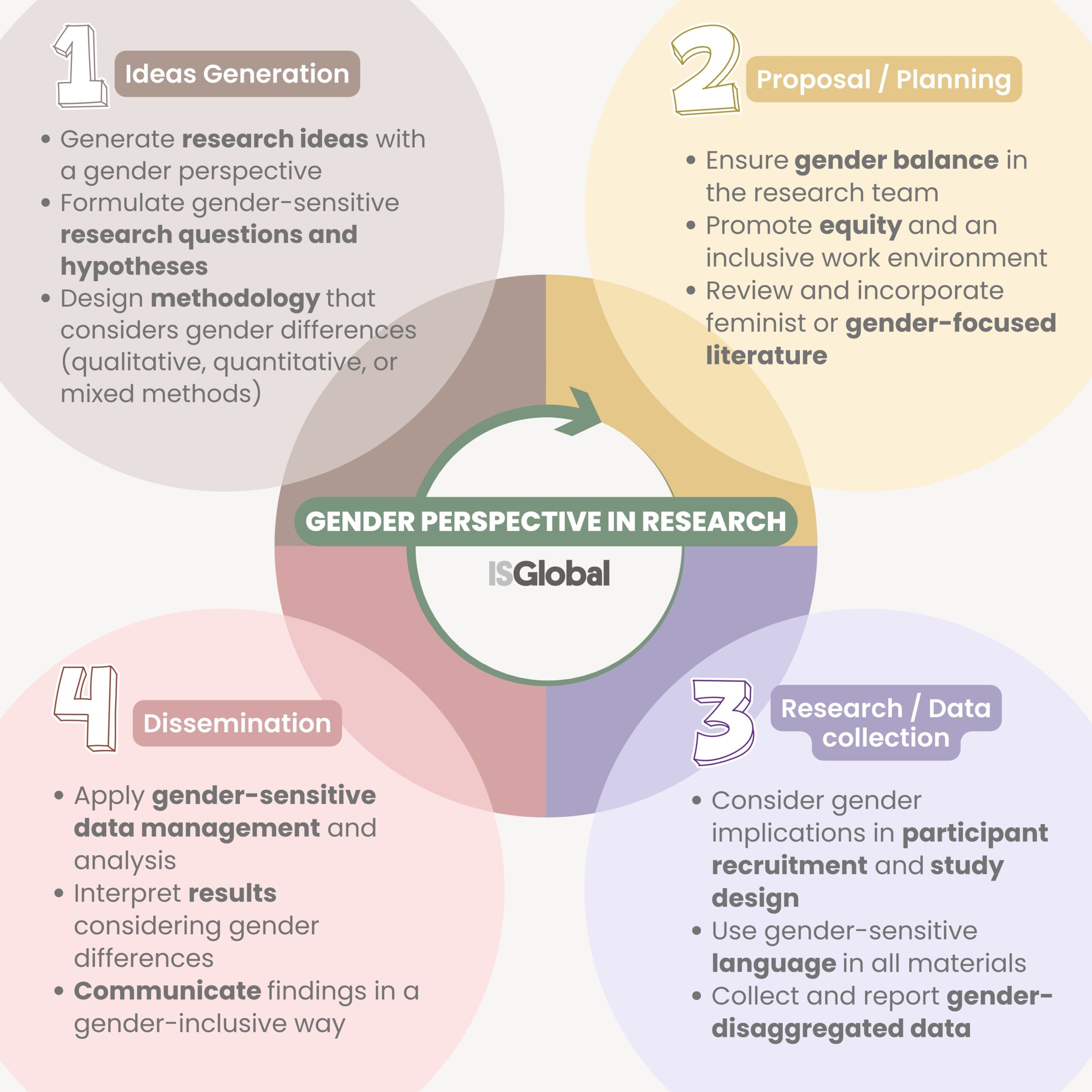
Adopting a gender perspective in research, development and innovation implies working towards gender equity, that is, ensuring that all people can develop their capacities without limitations imposed by gender roles. It also involves incorporating analyses that take into account both sex and gender at all stages of the research process, from the formulation of hypotheses to the communication of results, ensuring that all voices are present in decision-making. Practical tools exist, such as checklists to identify gender bias and communication guidelines, which can help us use more inclusive language.
READ MORE
COLLAPSE
- Women and Science: More Leadership and Better Research(ISGlobal, 2025)
- Gender and racialization bias in medicine and artificial intelligence applied to health(PRBB, 2025)
- Experts Show How Resilience to Alzheimer’s Differs by Sex and Gender(ISGlobal, 2024)
- An Equitable Future Where All Girls Can Study—and Be—Whatever They Want(ISGlobal, 2021)
- Women in Science: the Persisting Gap(ISGlobal, 2018)
- How can we incorporate a gender perspective into our research? (Universitat Pompeu Fabra)
- A theoretical framework for analyzing gender bias in epidemiological research: making the invisible visible(Universidad de Alicante)
MULTIMEDIA MATERIAL