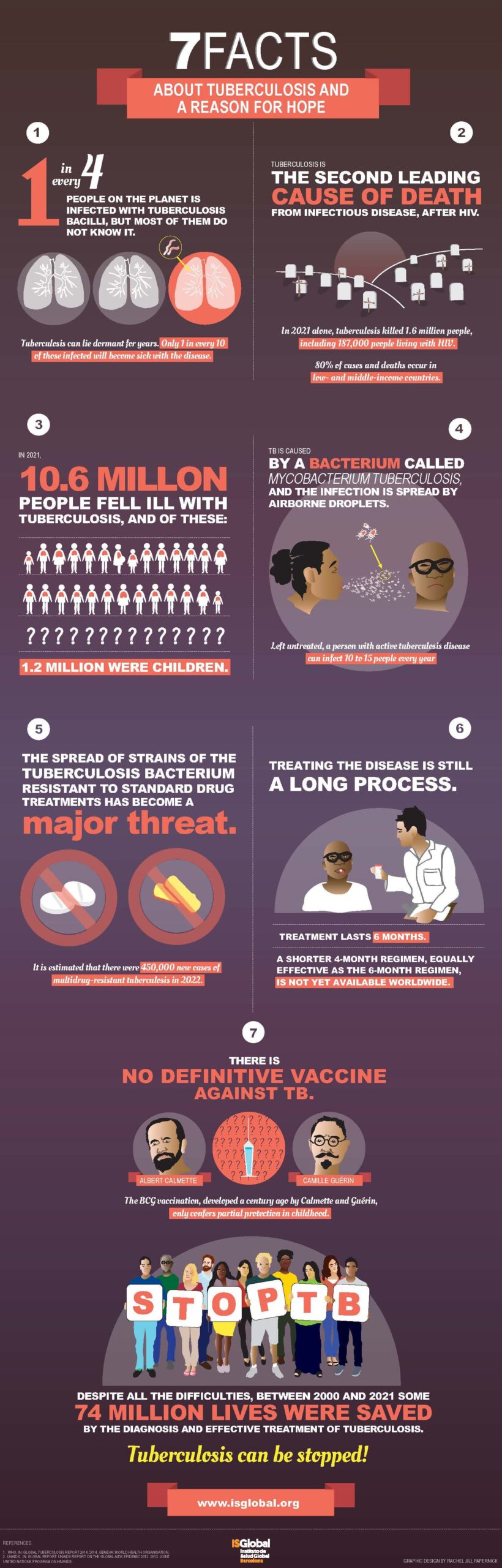

Tuberculosis
What is tuberculosis?
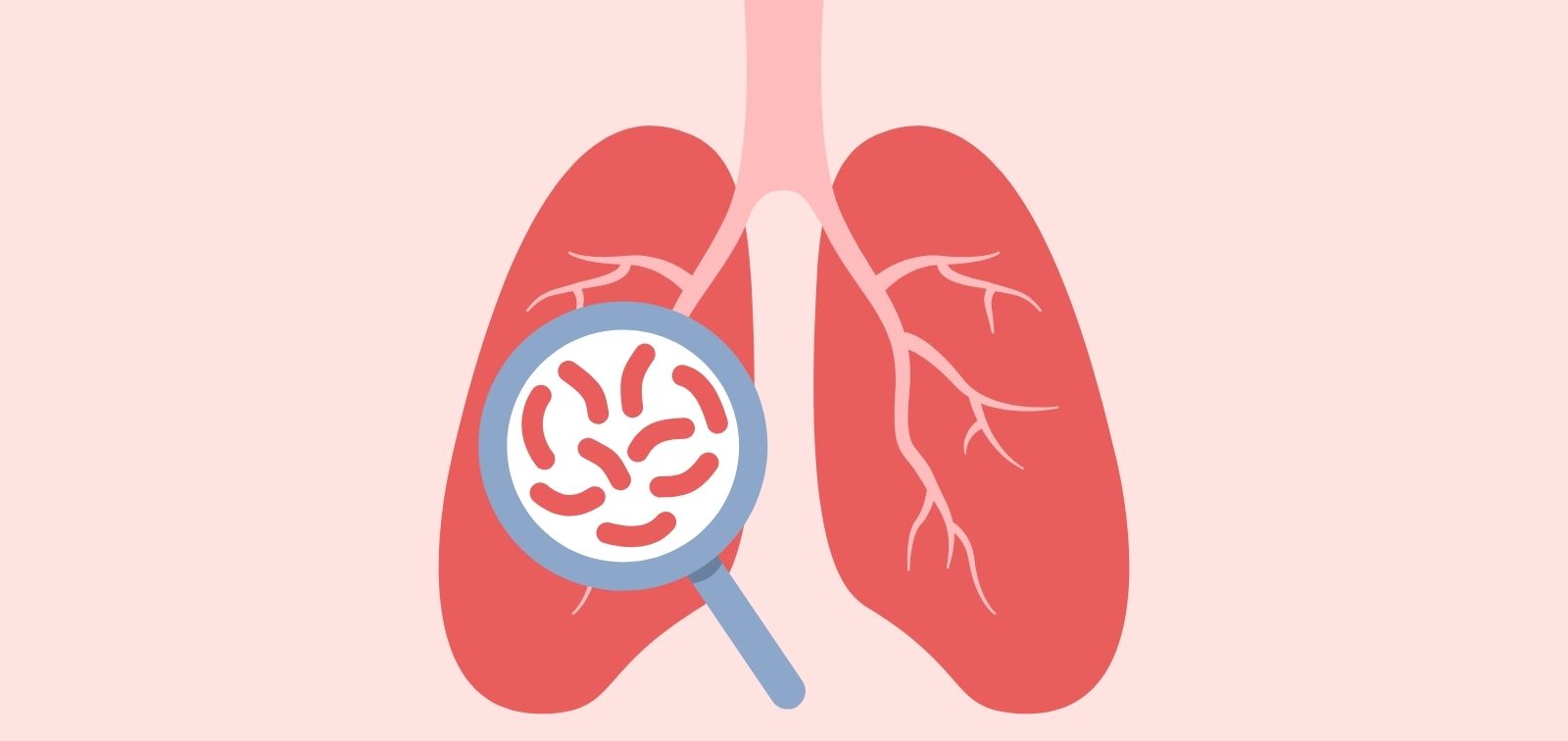
Tuberculosis (TB) is an infectious disease caused by bacteria that mainly affects the lungs, although it can also affect other organs. The most common cause is Mycobacterium tuberculosis, known as the Koch bacillus, a rod-shaped bacterium belonging to the group of mycobacteria.
It is estimated that around one quarter of the world’s population is infected with the tuberculosis bacillus, mostly in its latent form, meaning the bacteria remain in the body without causing symptoms or spreading the disease. According to data from the World Health Organization (WHO), about 10.7 million people developed tuberculosis in 2024. The disease affects people of all ages and is present in every country, although the highest incidence is concentrated in parts of Asia and Africa.
Tuberculosis is an airborne infectious disease, but it can be prevented and cured. Since 2000, health interventions have prevented more than 80 million deaths worldwide. Despite these advances, tuberculosis remains the leading cause of death from a single infectious agent worldwide, highlighting the importance of strengthening prevention, early detection and treatment.
Tuberculosis and HIV
People living with HIV have about a 12 times higher risk of developing TB, because the virus weakens the immune system and makes opportunistic infections more likely.
Tuberculosis is also one of the main causes of death among people with HIV, as the two infections make each other worse and can speed up the progression of disease. In 2024, around 150,000 people died from TB linked to HIV, with Africa being the most affected region. Expanding access to TB treatment and antiretroviral therapy since 2005 has helped prevent about 9.8 million deaths worldwide.
Transmission
Tuberculosis spreads through the air: bacteria are released when a person with TB coughs, sneezes, spits, or even when they speak or breathe, and other people may breathe them in. As with other respiratory infections, the risk of infection increases in closed, poorly ventilated or crowded spaces.
It is important to note that our understanding of transmission has changed: we now know that people do not need to have a strong cough to spread TB. Recent studies show that people without clear symptoms may also pass the bacteria to others.
People with latent TB infection (where the bacteria are “asleep”) or TB affecting organs outside the lungs do not usually spread the disease.
Tuberculosis does not spread by sharing personal objects, food or drinks, or through normal physical contact such as shaking hands, hugging or kissing.
Symptoms
Traditionally, TB was described as having two states, latent and active. However, current models use a more dynamic approach, where the disease can appear at different stages.
- Asymptomatic tuberculosis: Many people have active bacteria in their lungs but no symptoms (no cough, fever or tiredness). This stage is a “blind spot” for public health, because a person may spread the disease without feeling ill. It is estimated that up to 50% of detected cases in communities could be at this stage. This should not be confused with asymptomatic tuberculosis and latent infection; in latent infection the bacteria are “asleep”, do not cause disease and are not spread.
- Symptomatic tuberculosis: In other cases, symptoms appear slowly and may remain mild for months, which can delay diagnosis. Early symptoms are often non-specific, such as fever, tiredness, night sweats, general discomfort and weight loss. In pulmonary TB, a persistent cough (sometimes with blood) is common and may last for several weeks. This form spreads most easily.
- Extrapulmonary tuberculosis: Although the lungs are most often affected, between 10% and 20% of cases involve other organs (such as bones, lymph nodes, the genitourinary system or the nervous system), especially in people with weakened immune systems. Symptoms depend on the organ affected and these forms are usually not infectious.
Diagnosis and treatment
For a fast and accurate diagnosis, the WHO currently recommends the use of molecular tests. These technologies analyse the DNA of the bacteria in just a few hours, making it possible to confirm whether the disease is present and whether standard antibiotics will work. There are also techniques based on biomarkers, which look for signs of the bacteria in urine or blood and are useful in people with very weak immune systems. To identify whether a person has latent infection (the bacteria are “asleep”), other complementary tools are used, such as the tuberculin skin test (PPD), interferon gamma release assays (IGRA), and new-generation skin tests.
Tuberculosis is treated with antibiotics, and the treatment approach depends on the situation:
To cure the disease: If tuberculosis is already active, treatment usually lasts between 4 and 6 months (using medicines such as rifampicin and isoniazid). It is very important not to stop treatment too early and to take the medication correctly, otherwise the bacteria may become resistant to the drugs.
To prevent the disease: In the case of latent infection, preventive treatment is available. Thanks to recent advances, we now have much simpler options that last between 1 and 3 months, preventing the disease from developing in the future.
In addition to medical treatment, the social determinants of health have a strong influence on recovery. Factors such as good nutrition, a stable economic situation and access to healthcare help people complete their treatment.
Multidrug-resistant tuberculosis
Tuberculosis is one of the diseases most closely linked to antibiotic resistance. Multidrug-resistant tuberculosis (MDR-TB) occurs when the bacteria do not respond to the usual first-line medicines. In these cases, different drugs must be used, which are usually more expensive, need to be taken for longer, and may cause more side effects. In more severe situations, extensively drug-resistant tuberculosis (XDR-TB) can develop, in which treatment options are very limited.
Prevention
The most important measures to prevent tuberculosis are early detection of cases, correctly following treatment and improving living conditions. Ventilating indoor spaces and maintaining good respiratory hygiene (for example, covering the mouth when coughing or sneezing) helps reduce transmission. It is also recommended to see a doctor if symptoms such as a persistent cough, fever or night sweats appear, or after close contact with a person with TB, even if there are no symptoms, in order to assess whether preventive treatment should start. Not smoking and maintaining healthy lifestyle habits also helps reduce the risk of disease.
BCG vaccine (Bacillus Calmette–Guérin)
The BCG vaccine is one of the main tools for preventing severe forms of tuberculosis. It is given mainly in childhood and provides protection especially against the most serious forms of the disease. Although the vaccine does not prevent all cases of pulmonary tuberculosis in adults, it is still very useful in countries where TB is common and forms part of public health strategies to control its spread.
READ MORE
COLLAPSE
- Molecular Stool Test Could Improve Detection of Tuberculosis in Adults with HIV(ISGlobal, 2025)
- One of the World’s Largest Social Programmes Greatly Reduced Tuberculosis Among the Most Vulnerable(ISGlobal, 2025)
- The Silent Spread: How Half of the World’s TB Cases Fly under the Radar(ISGlobal, 2025)
- Using Stool-Based Molecular Tests to Improve Tuberculosis Diagnosis in Children(ISGlobal, 2024)
- Improving Tuberculosis (TB) Detection in Children and People Living with HIV, a Global Priority(ISGlobal, 2024)
- The Use of Rapid Tests to Diagnose Tuberculosis among People with HIV in Africa has Increased, but Barriers to Implementation Remain(ISGlobal, 2023)
- Drug-Resistant Tuberculosis May Be Under-Diagnosed, Says Genomic Analysis in Southern Mozambique(ISGlobal, 2023)
- How Many People Die From Tuberculosis Every Year?(ISGlobal, 2018)
- Ending Tuberculosis: an Ambitious but Not Impossible Challenge(ISGlobal, 2016)
MULTIMEDIA MATERIAL