

Social Determinants of Health

What are the social determinants of health?
Social determinants of health (SDH) are the set of social conditions in which people are born, grow, live and age, which decisively influence their health status and wellbeing. They include the material circumstances of everyday life (housing, food, employment…), but also relational and psychological factors, such as social support or stress.
Health status does not depend exclusively on the healthcare system, but is shaped by external factors. Educational attainment, income, employment stability, urban and environmental conditions, decent quality housing, and the availability of clean air and water have a greater influence on population health outcomes than medical care itself.
Social determinants and the social gradient in health
A central feature of the social determinants is the social gradient in health: health indicators progressively worsen as social disadvantage increases.
Populations with lower educational or economic levels experience a greater burden of disease and lower life expectancy. This relationship is not limited to extreme poverty but is continuous across the entire social scale; social determinants of health affect both low- and middle-income countries and high-income countries. Within the same country, and even within the same city, substantial differences in life expectancy are observed according to area of residence and socioeconomic status.
Although this is a global issue, in some groups the social determinants of health are more evident. According to WHO, Indigenous populations have a lower life expectancy than non-Indigenous populations, both in low- and middle-income countries and in high-income countries. In addition, before the age of 5, children born in low-income countries are 13 times more likely to die than those born in high-income countries.
Social determinants are embedded within public policies and economic systems, which represent the real opportunities each person has to lead a healthy life. Urban planning, labour and education policies, as well as development programmes, shape the incidence and prevalence of diseases, as well as morbidity and mortality, a key epidemiological indicator combining complication/disease rates and the associated risk of death.
What does addressing the social determinants involve?
From a public health perspective, addressing the social determinants means acting before disease onset by modifying non-medical factors that contribute to its occurrence. This represents a challenge for policymakers, institutions and health professionals, as it requires intersectoral policies that ensure the necessary conditions for a dignified and healthy life for the entire population. Acting on the social determinants is essential to improve health equity.
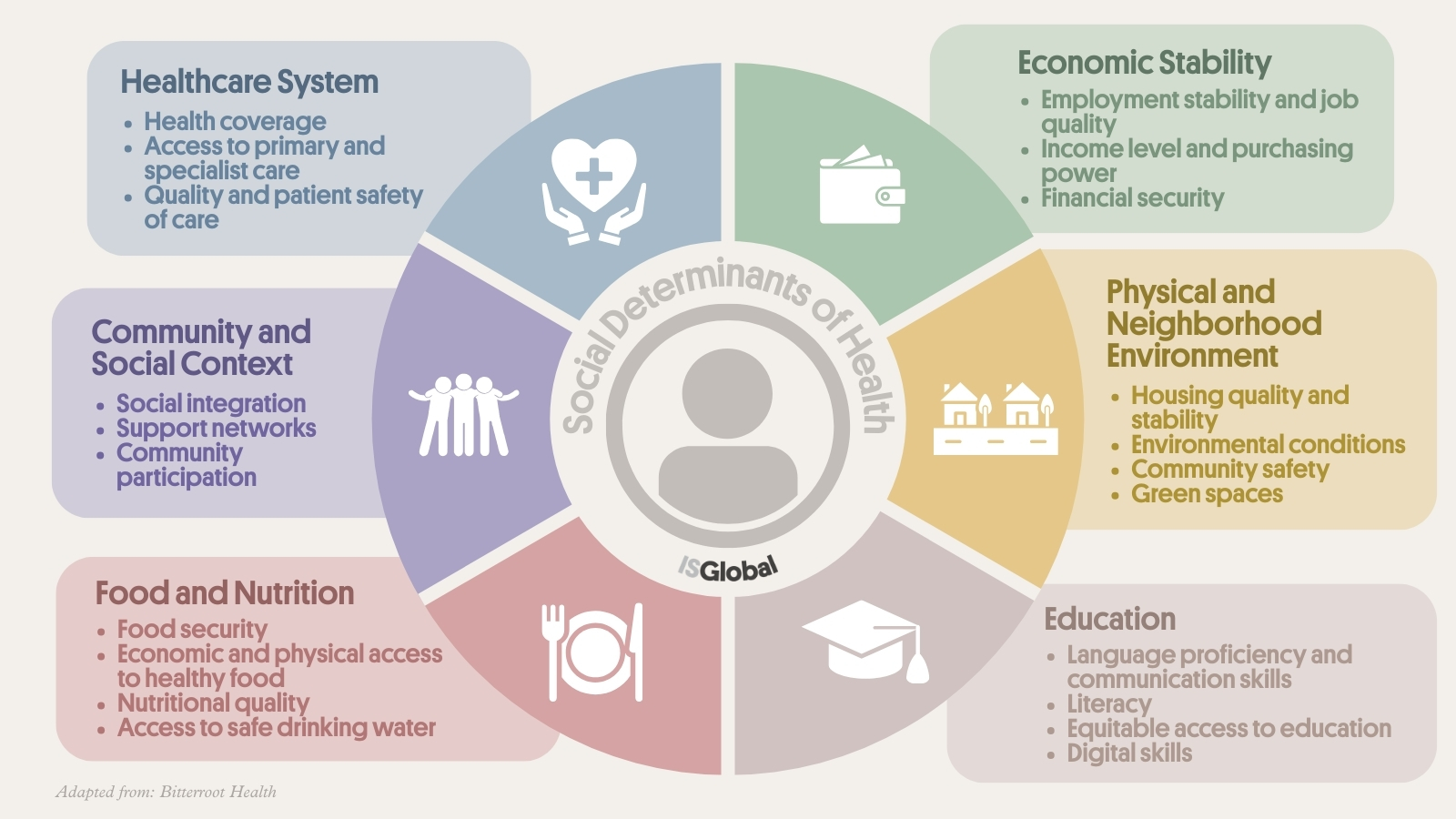
Key social determinants of health: social, economic and environmental conditions influencing population health outcomes, including mortality, morbidity and life expectancy.
READ MORE
COLLAPSE
- From Poverty to Dignity: Building Health through Social Protection(ISGlobal, 2025)
- One of the World’s Largest Social Programmes Greatly Reduced Tuberculosis Among the Most Vulnerable(ISGlobal, 2025)
- Conditional Cash Transfers Significantly Reduce AIDS Incidence and Mortality Among Brazil’s Most Vulnerable Women(ISGlobal, 2025)
- Social Programmes Save Lives... and Could Save Many More(ISGlobal, 2024)
- Conditional Cash Transfer Programmes Have Prevented 739,919 Child Deaths in Latin America(ISGlobal, 2023)
- Racism, Poverty, and Illiteracy Increase the Risk of Contracting and Succumbing to AIDS(ISGlobal, 2023)
- Cash Transfer Social Programmes Can Reduce Maternal Mortality(ISGlobal, 2021)
MULTIMEDIA MATERIAL