

Planetary Health

What is it?
Planetary health is an interdisciplinary and global approach that seeks to ensure human well-being and the balance of the ecosystems on which we depend. It focuses on studying the relationship between human health and the state of the environment, recognising that environmental degradation, climate change, biodiversity loss and pollution directly affect our quality of life and the planet’s sustainability.
This concept, promoted in 2015 by the Rockefeller-Lancet Commission on Planetary Health, encourages innovative and sustainable solutions through collaboration between disciplines such as economics, agriculture, energy and nutrition. The Planetary Health Alliance, an international network of academic institutions and research centres, has played a key role in consolidating this field.
Planetary health and planetary boundaries
Over the past century, humanity has achieved significant progress in health and well-being, such as reducing child mortality, increasing life expectancy and decreasing poverty. However, these advances have come, in part, at the cost of intensive exploitation of natural resources, putting at risk the well-being of present and future generations.
Human activities, such as energy generation and food production, have profoundly altered Earth’s systems. To guide a more sustainable relationship, in 2015 the framework of the nine planetary boundaries was established, within which humanity can safely develop. According to the 2025 update, seven of them have already been transgressed:
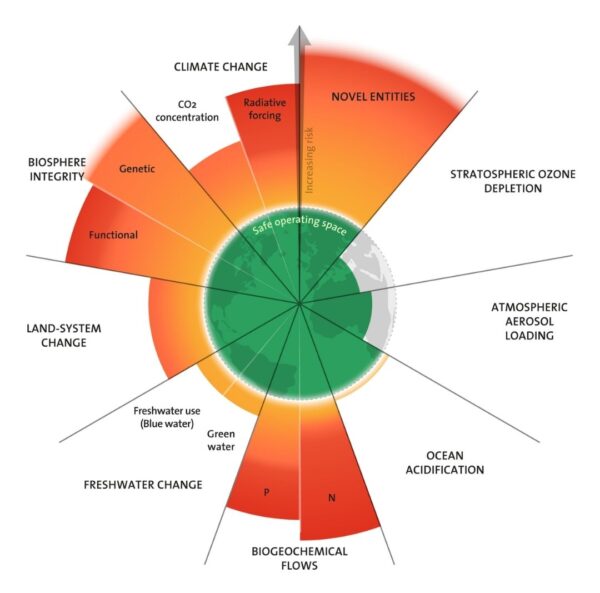
2025 update of the planetary boundaries. Source: Azote/Stockholm Resilience Centre, based on analysis by Sakschewski and Caesar et al. 2025.
The nine planetary boundaries and their status
- Climate change. The rise in greenhouse gases is driving global temperature increases and disrupting weather patterns. This boundary has been crossed, and CO₂ concentrations continue to rise.
- Novel entities. The amount of synthetic substances released into the environment without adequate safety testing places novel entities in a high-risk zone. The massive release of synthetic substances and other technological interventions has exceeded the planetary boundary, putting Earth’s functioning in a high-risk zone.
- Stratospheric ozone depletion. The ozone layer, damaged by artificial chemicals, has been recovering since the late 1980s. Today, this boundary is considered to be within the safe operating space.
- Atmospheric aerosol loading. Changes in airborne particles, although already affecting monsoons, forests and marine ecosystems, are still considered to be within the safe operating space according to the planetary boundary framework.
- Ocean acidification. The absorption of CO₂ has increased ocean acidity by 30–40% since the industrial era, surpassing the planetary boundary for the first time and threatening both marine ecosystems and the ocean’s capacity to regulate the climate.
- Alteration of biogeochemical flows. The nitrogen and phosphorus cycles have been profoundly altered by agriculture and industry, meaning the planetary boundary for biogeochemical flows has already been exceeded.
- Freshwater change. Human alterations to rivers, lakes and soil moisture have surpassed the planetary boundary for freshwater, endangering key functions such as biodiversity and rainfall patterns.
- Land-system change. Deforestation and urbanisation have reduced tropical, boreal and temperate forests below safe levels, exceeding the planetary boundary for landscape transformation and affecting biodiversity and vital ecological functions.
- Biosphere integrity. The loss of biodiversity, both genetic and functional, has gone beyond safe levels and threatens planetary stability by disrupting its energy and chemical balance.
Source: Stockholm Resilience Centre
The link between planetary health and human health
While planetary boundaries measure the biophysical processes that sustain Earth’s stability (that is, they show us how far we can “push the planet” without endangering it), planetary health examines how these changes affect human health.
When we cross planetary boundaries, it is not only the climate or ecosystems that are affected — our health is too. For example, infectious and non-communicable diseases increase, nutritional problems emerge, maternal and child health is compromised, and social instability rises. Caring for the planet’s stability is therefore not only an environmental issue but also a matter of global public health.
Environmental justice
There is growing discussion about moving towards “safe and just” planetary boundaries, which include justice as a central criterion. It is not enough to define how far human pressure on Earth can go from a biophysical perspective; we must also ensure that resources are distributed equitably.
This translates into three types of justice:
- Intergenerational justice (between generations): we have a responsibility to protect the environment to ensure the well-being of future generations.
- Intragenerational justice (within the same generation): we must reduce inequalities between countries, communities and individuals, taking into account factors such as gender, age and socioeconomic status.
- Inter-species justice: we must recognise that human health depends on diverse ecosystems, which we must also protect.
The health impact lies at the heart of this vision of justice, because environmental damage does not affect everyone equally. Those who have contributed the least to causing it — such as Indigenous peoples, low-income communities or future generations — are often the ones who suffer its consequences the most.
READ MORE
COLLAPSE
- Planetary Health(ISGlobal)
- Human Health Depends on the Planet Resources(ISGlobal, 2019)
- Why Is Planetary Health the Solution to Prevent Crises Like COVID-19?(ISGlobal, 2020)
- 7 Facts Showing Why Our Health Depends on the Environment(ISGlobal, 2020)
MULTIMEDIA MATERIAL